

On The Journey With All Of You-Thinking About The Cross
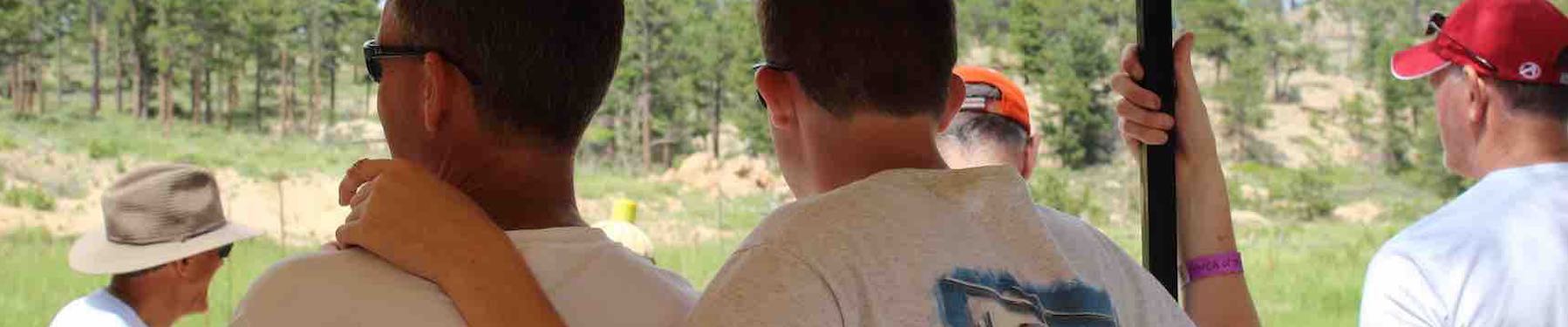
While on the trail I have always enjoyed the pause, the stop to sit on a rock, to look around, to embrace the landscape, to sip some water and take in where I am. This piece is one such pause. It has everything to do with our collective journey through John’s Gospel account.
If you had asked me years ago what the Cross was about, I would have answered quickly and confidently. I would have said it was about payment. Justice satisfied. God’s wrath poured out so that I could be forgiven. It made sense to me then. It fit the framework I had inherited. It was tidy.
But if I’m honest, beneath that framework there grew an unsettledness. The pieces neatly fit. Yet over time it began to misalign with the God I met in Jesus.
Today, I begin this reflection carrying the belief that reality itself is fundamentally connected. Not just spiritually, but at the deepest level of existence. Humanity is not a collection of isolated individuals standing before God as separate accounts to be settled. We share one human life. We belong to one another, all of us.
And if this is true, then what God does in and through the incarnation is not a private transaction for a few, but participation with the whole.
I don’t believe God had an identity change at the Cross. I don’t believe He shifted from wrathful to loving. I don’t think the Cross was God calming Himself down. I believe God has always been love.
The Cross begins with the incarnation. “The Word became flesh.” God did not observe humanity from a distance. He entered it, fully. He assumed our humanity to the deepest degree. If humanity is connected at its core, then when Christ takes on human nature, He stands fully inside that shared life.
This means that when Jesus died, He does not merely die for us. He dies as us.
This isn’t a new idea. The early church spoke this way. And sitting here on this rock, pausing while on our journey, it makes more sense to me than anything else.
Paul says we were buried with Him. Raised with Him. I no longer see that as future only. I see it as present reality. Resurrection is not simply an event at the end of time. It is the unveiling of what is already true, life always follows a death.
And what this means is this: I do not have to live wearing the handcuffs I have so often fastened on myself.
For years I believed the central problem was that God was offended and needed satisfaction. Now I see the deeper problem as shame, the quiet assumption that I do not measure up. Not because God declared it, but because somewhere along the way I came to suspect His love. And in so doing I’m reaching once again for those cuffs.
Genesis 3 reads differently to me now. The shift was not God withdrawing love. It was humanity suspecting God’s love. Once suspicion entered, shame followed. Once shame followed, hiding followed. And once hiding followed, performance and comparison quickly took over, the cuffs clasped tight.
The Cross, then, is not God responding to that suspicion with punishment. It is God stepping directly into that shame and absorbing it without retaliation. Jesus said, I came to set you free.
As I have grown older, I have also come to see that theology does not float above human experience. It grows out of it. When I was younger, it seemed straightforward: What does the Bible say? Just do it. But life is not that mechanical. We all read Scripture from somewhere. If our experience is shaped by insecurity or shame, our theology will reflect that, thus the cuffs. If our experience is transformed by love, theology slowly begins to reflect that as well, thus freedom.
And here I want to speak carefully, because I speak as one who is inside the Church, formed by her, grateful for her, still belonging to her.
From within that belonging, I sense a tension. Not a failure of faith, and not simply bad doctrine, but a deep tension between believing we are loved and actually living as if we are loved.
If we secretly believe we are not enough, we will construct systems to secure ourselves. We will draw thick lines. We will define who is in and who is out. We will emphasize being right. Even our understanding of the Cross can become a way to steady anxiety rather than receive love.
But what if the Cross is not a mechanism to manage divine anger, but the revelation that God has never turned from us at all?
I believe in wrath. But I no longer see it as directed at humanity. I see it as God’s holy opposition to what destroys humanity: sin, evil, death. Not because humanity makes Him angry, but because humanity is loved. Wrath, in this sense, is protective. It is resistance to the disease, not rejection of the patient.
The Cross is not a battlefield where God defeats a rival in a contest of strength. It is the place where self-giving love exposes the emptiness of destructive power. Evil feeds on fear, accusation, and separation. When those are absorbed and not returned, evil begins to suffocate.
The grain of wheat falling into the ground seems woven into this reality. Clinging leads to conflict. Letting go leads to life. Jesus did not merely teach that pattern. He embodied it. And because He entered our shared humanity completely, that life is not simply an example to imitate, it is a life to participate in.
I believe what Christ has done is for all humanity. Not only for those who manage to navigate prescribed hoops. The promise to Abraham was that through him all nations would be blessed. I see the Church inside that promise, not as gatekeeper, but as blessing.
Judgment, in this light, is not vindictive punishment. It is revelation. It is reality unveiled.
From Genesis to Revelation, I see one consistent intention: “I will be your God, and you will be my people, and I will dwell in the midst of you.” The final vision is not separation, but dwelling together.
I do not pretend to have every detail worked out. I am not certain about the mechanics of restoration. But I trust the character of God more than I once trusted my inherited explanations.
So at this pause on the trail with all of you, here is where I find myself:
God has always been love.
Christ entered our humanity completely.
We died and rose with Him.
Freedom is learning to live from that reality.
And the Church is meant to embody that freedom as a blessing to the world.
It’s been good to sit here together for a moment, to look out over the landscape and take it in.
But the trail continues. It’s time to stand, gather my things.
Because who knows what might be around the next bend.
Thanks for setting with me.
Mike, March 2, 2026